

What is a UUID? The Complete Guide for Developers
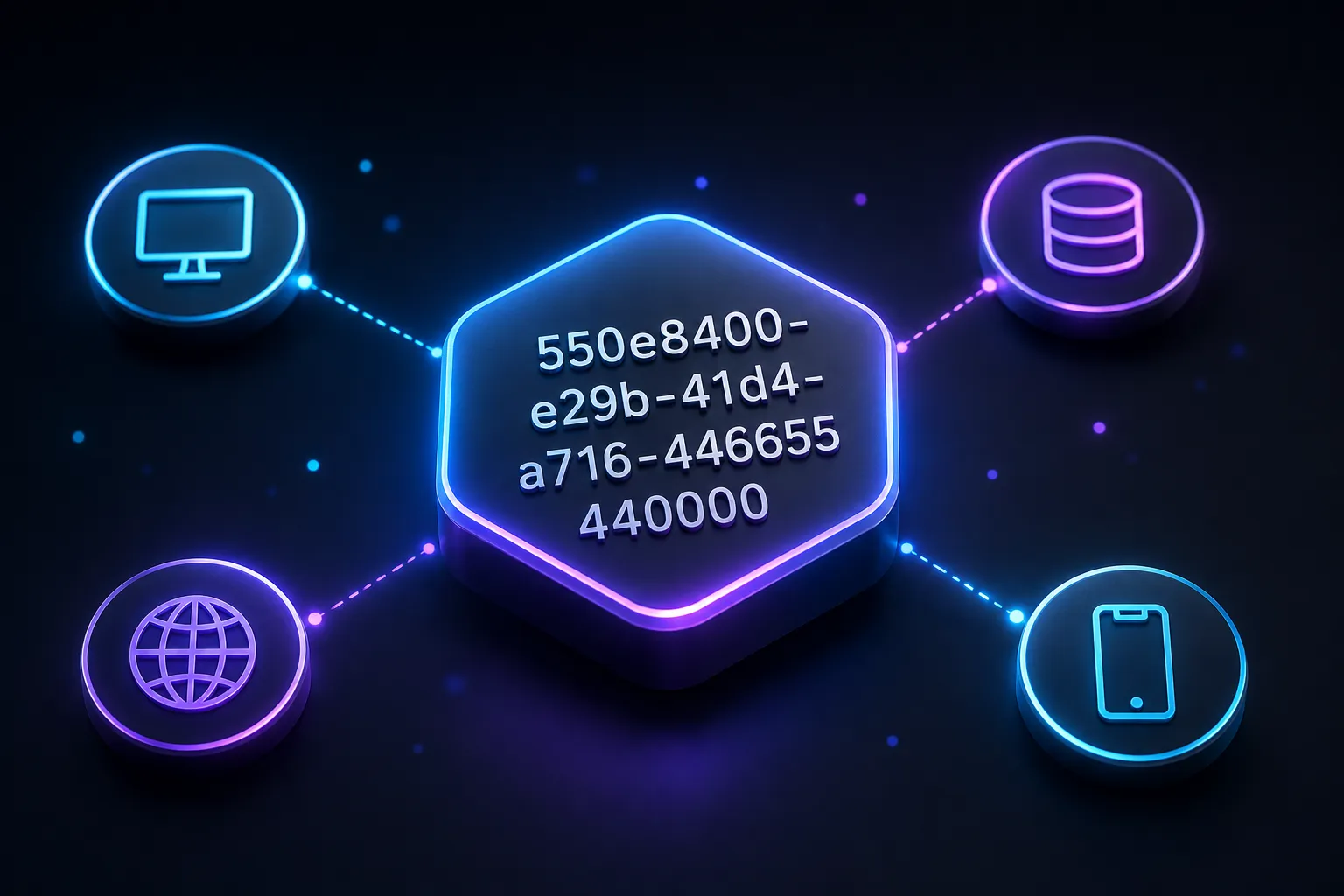
If you've ever looked at a database table or a modern API response, you've likely seen a long, hyphenated string of random letters and numbers that looks something like this: 123e4567-e89b-12d3-a456-426614174000.
That is a UUID (Universally Unique Identifier). But why do we use them instead of simple auto-incrementing numbers (like 1, 2, 3)? Let's dive in.
The Problem with Sequential IDs
In traditional, single-server relational databases, auto-incrementing integers work perfectly. The database just adds 1 to the last ID used.
However, in modern distributed systems, microservices, and offline-first mobile apps, relying on a central database to assign the "next" ID creates a massive bottleneck. If two servers try to create a record at the exact same millisecond, they might both assign ID 1050, resulting in a catastrophic data collision.
Enter the UUID
A UUID is a 128-bit label that guarantees uniqueness across space and time. The genius of a UUID is that it can be generated anywhere—on a frontend client, a backend server, or a mobile device—without needing to check a central database first.
The chance of a collision (two systems generating the exact same UUID) is so infinitesimally small that it is statistically zero.
Understanding UUID Version 4
There are several versions of UUIDs, but Version 4 (v4) is the most common today. Unlike v1 (which uses your computer's MAC address and the current time), v4 is entirely random. It relies on cryptographically secure pseudorandom number generators (CSPRNG) to create the identifier.
👉 Need a UUID right now? Generate one securely with our UUID Generator.
When Should You Use UUIDs?
- Distributed Databases: When using NoSQL databases like MongoDB or Cassandra across multiple regions.
- Client-Side Generation: When a React or iOS app needs to create an object and link it to other objects before syncing with the backend.
- Security: Sequential IDs allow attackers to guess how many users you have or easily scrape endpoints (e.g.,
api/users/5). UUIDs are unguessable.
Conclusion
UUIDs are the backbone of modern, scalable architecture. While they take up more storage space than standard integers, the flexibility and safety they provide for distributed systems are unmatched.
Explore more secure identifiers in our Cryptography Tools section.