

URL Encoding Explained: Navigating Web Development Safely
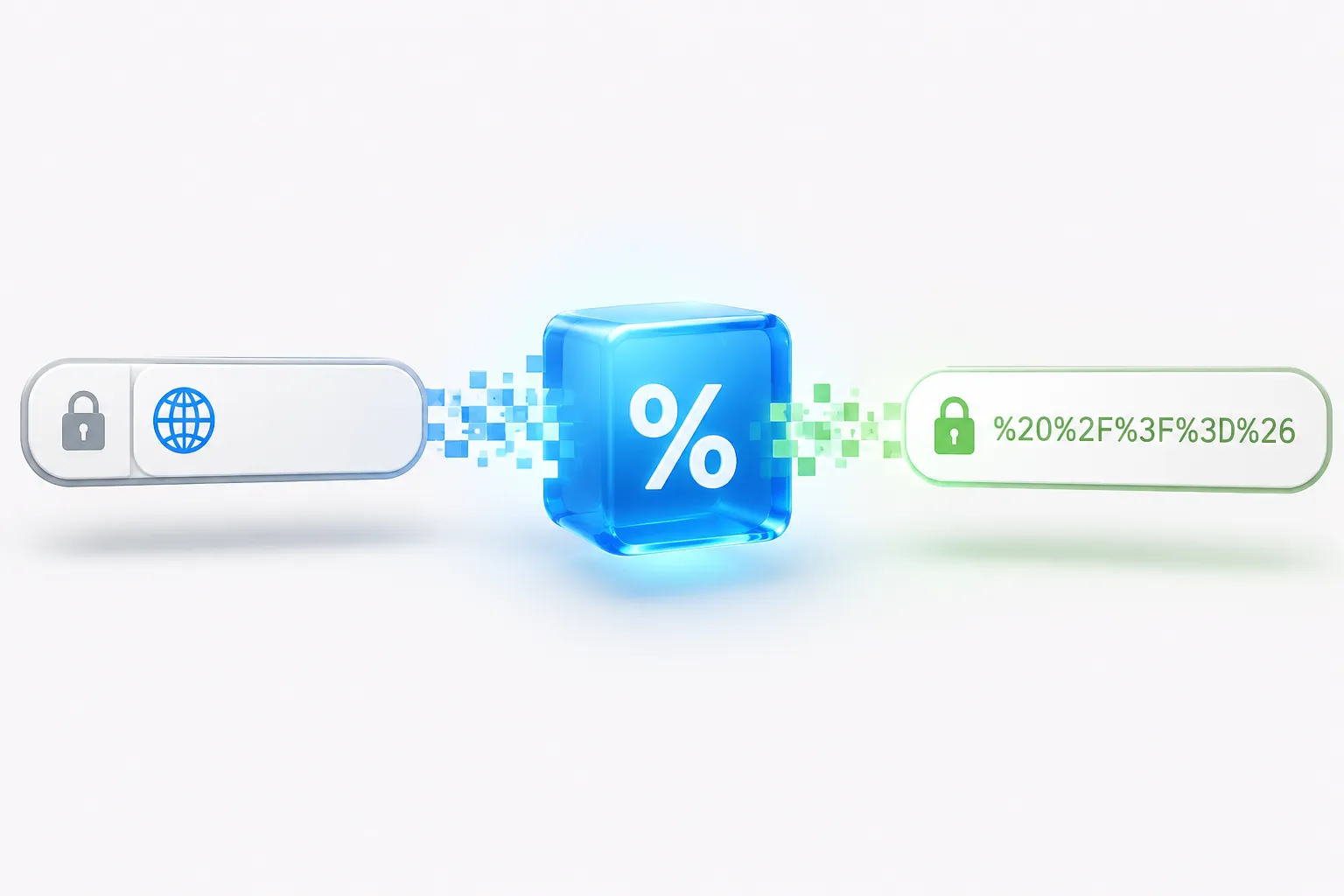
Have you ever copied a link to a website, only to paste it and see a chaotic mess of %20 and %3F symbols? That chaotic mess is actually a vital internet standard known as URL Encoding (or Percent-Encoding).
In this guide, we'll explain why it happens, why web developers depend on it, and how you can easily decode it.
Why URLs Break
The Internet runs on strict rules. According to the foundational RFC 3986 standard, URLs can only be sent over the internet using the US-ASCII character set.
But what happens if your URL contains a space, an emoji, or a special character like & or =? If you send an unencoded space in a URL, the web server might interpret it as the end of the address, breaking the link entirely.
How URL Encoding Fixes It
URL encoding solves this by replacing unsafe characters with a % followed by their two-digit hexadecimal equivalent.
- A space
%20 - An ampersand
&becomes%26 - A slash
/becomes%2F
This ensures that the web browser and the server know exactly what the character is supposed to be, without accidentally triggering a structural command in the URL.
The Developer's Dilemma
When building APIs or processing webhooks, developers constantly need to pass complex data (like JSON or redirect URLs) inside other URLs via query parameters. If they forget to encode this data, the application will crash.
👉 Are you debugging a broken link or building an API? Safely format your strings with our URL Encoder / Decoder.
Conclusion
URL Encoding is a silent hero of the internet. It ensures that regardless of language, symbols, or spaces, links work flawlessly across the globe. By using reliable Internet Tools, developers can ensure their applications remain bug-free and standard-compliant.